
Passwords remain essential for digital identity and access management, despite predictions that they would become obsolete. Today, organizations depend on countless credentials to protect cloud applications, business systems, privileged accounts, databases, and remote access infrastructure. Meanwhile, cybercriminals are becoming more sophisticated, using artificial intelligence, credential theft malware, phishing campaigns, and automated attacks to compromise user accounts.
As businesses face evolving threats, password managers have shifted from basic credential storage to more robust security platforms. Modern password managers now play a vital role in identity security, compliance, privileged access management, and Zero Trust initiatives.
As we head into 2026, several key trends will influence the future of password management. Organizations that recognize these developments will be better equipped to safeguard sensitive data, enhance user experience, and boost cybersecurity resilience.
In this blog, we highlight the key password manager trends businesses should pay attention to in 2026.
1. AI-Powered Threat Detection Is Becoming a Key Password Management Feature
Artificial intelligence is changing both cyberattacks and cybersecurity defenses. Attackers are increasingly using AI to automate phishing campaigns, create convincing social engineering messages, and pinpoint vulnerable targets. Meanwhile, password management vendors are integrating AI into their platforms for enhanced security.
Modern password managers are starting to use AI to recognize unusual login behaviors, detect suspicious credential access patterns, and flag potential account compromises before they escalate.
For instance, AI-powered monitoring can identify cases where an employee suddenly accesses credentials outside normal working hours, tries to retrieve unusually large numbers of passwords, or logs in from unfamiliar locations.
Organizations are also leveraging AI to assess password hygiene across the enterprise. Instead of relying solely on periodic audits, password managers can continuously identify weak passwords, reused credentials, and accounts vulnerable to attack.
As AI-driven cyber threats increase, intelligent credential monitoring will become a standard feature rather than a premium offering.
2. Passwordless Authentication Is Growing
The shift towards passwordless authentication is speeding up as organizations look to lessen their reliance on traditional passwords.
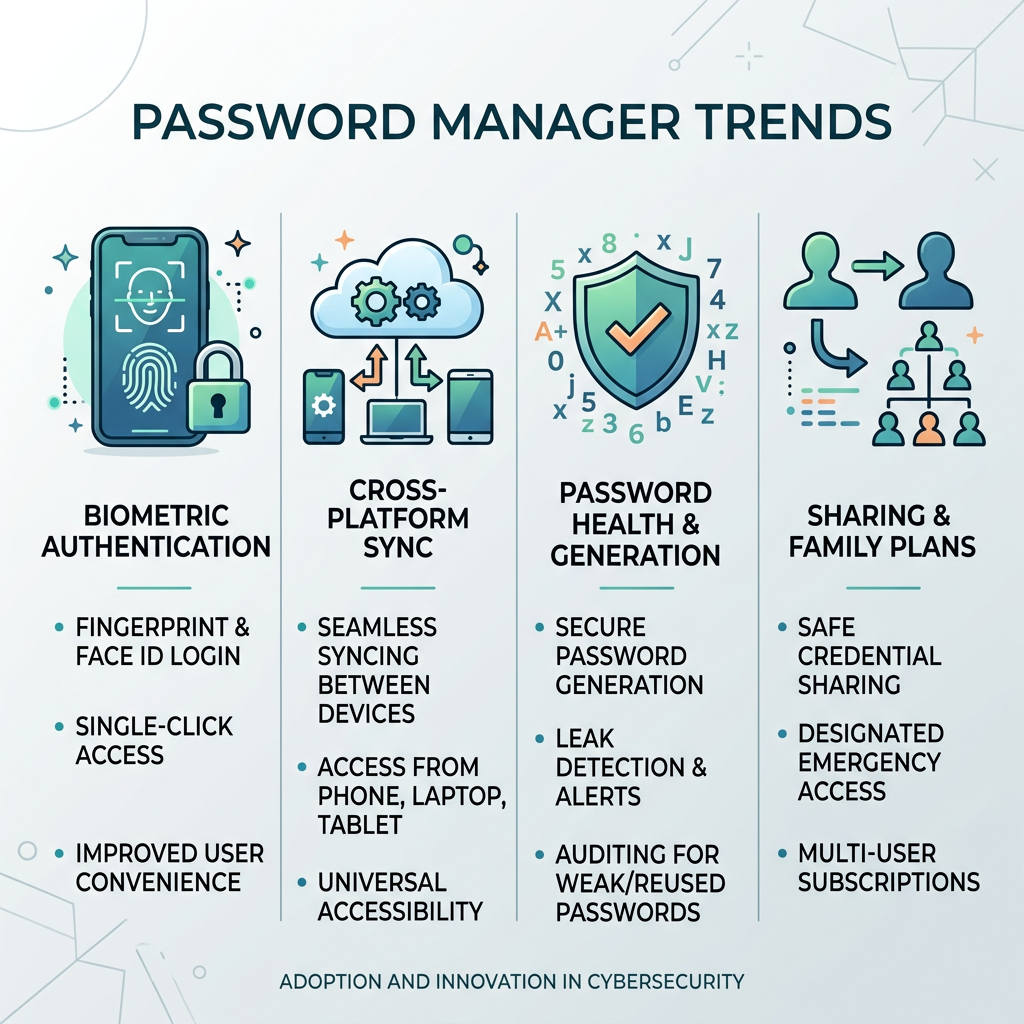
Technologies like passkeys, biometric authentication, hardware security keys, and device-based authentication are becoming more common in enterprise environments.
Passwordless authentication has several benefits. It lowers phishing risks, improves user experience, and removes many challenges related to password creation and management.
However, despite increased adoption, passwords are unlikely to vanish completely in the near future. Many organizations still use a mix of legacy systems, cloud applications, and third-party platforms that require password-based authentication.
Consequently, password managers are adapting to support hybrid settings where passwords and passwordless authentication coexist.
Rather than becoming outdated, password managers are positioning themselves as identity management hubs that securely handle both traditional credentials and modern authentication methods.
3. Zero Trust Security Is Encouraging Password Management Adoption
Zero Trust has emerged as one of the most significant cybersecurity frameworks in recent years.
The main idea behind Zero Trust is straightforward: never trust, always verify.
Every access request must be authenticated, authorized, and continuously validated, no matter where the user is located.
Password managers play an important role in supporting Zero Trust strategies by enhancing identity verification and reducing risks related to credentials.
Organizations adopting Zero Trust increasingly rely on password managers to:
- Eliminate password reuse
- Enforce strong authentication policies
- Support multi-factor authentication
- Centralize credential governance
- Improve access visibility
In 2026, password management solutions will integrate more closely with Zero Trust architectures, assisting organizations in verifying identities continuously while ensuring secure access in distributed environments.
As remote work and cloud adoption continue to grow, the link between password management and Zero Trust will become even more crucial.
4. Multi-Factor Authentication Is Essential
For years, cybersecurity experts have promoted multi-factor authentication (MFA) as one of the best defenses against credential theft.
By 2026, MFA is no longer seen as an optional security enhancement. It is becoming a baseline requirement for securing enterprise credentials.
Modern password managers increasingly offer built-in MFA capabilities and support various authentication methods, including authenticator apps, biometrics, hardware security keys, and adaptive authentication technologies.
Organizations are shifting away from SMS-based MFA in favor of stronger authentication methods that provide better protection against phishing and SIM-swapping attacks.
Password managers are also making MFA deployment easier by allowing administrators to enforce authentication policies centrally across users and applications.
As regulatory demands tighten and cyberattacks become more advanced, integrating MFA will remain one of the most important password management trends.
5. Enterprise Password Managers Are Evolving Into Identity Security Platforms
Traditional password managers mostly focused on securely storing and retrieving credentials.
Today, enterprise password managers are transforming into broader identity security platforms that offer much more capability.
Modern solutions now often include:
- Privileged credential management
- Session monitoring
- Access governance
- Password rotation
- Secure credential sharing
- Identity analytics
- Compliance reporting
Organizations are seeking all-in-one security platforms that simplify management while enhancing visibility into user access and credential usage.
This merging of password management, identity governance, and privileged access management is expected to accelerate in 2026.
Businesses want centralized control over identities, credentials, and privileged access without juggling multiple disconnected tools.
As a result, password managers are becoming strategic parts of enterprise identity ecosystems rather than separate security products.
6. Compliance and Audit Readiness Are Boosting Adoption
Regulatory compliance continues to drive investments in password management.
Organizations face increasing pressure to show they have strong access controls, protect sensitive data, and maintain detailed audit trails.
Frameworks like GDPR, HIPAA, PCI DSS, ISO 27001, SOC 2, and NIST emphasize the importance of identity security and credential protection.
Password managers assist organizations in meeting compliance needs by:
- Enforcing password policies
- Tracking credential usage
- Maintaining detailed audit logs
- Supporting access reviews
- Strengthening authentication controls
In 2026, automating compliance will be a key differentiator among enterprise password management solutions.
Security teams are looking for tools that not only enhance protection but also make audit preparation and reporting easier.
Password managers that provide built-in compliance dashboards and automated evidence collection will gain traction in regulated industries.
7. Secure Credential Sharing Is Now Essential for Business
Modern workplaces rely heavily on collaboration.
Employees, contractors, vendors, and third-party partners often require shared access to applications, cloud services, and business systems.
Sadly, many organizations still use unsafe methods to share credentials, such as email, spreadsheets, messaging apps, and shared documents.
These methods pose significant security risks and complicate accountability.
Password managers are addressing this issue with secure credential-sharing features that let users grant access without exposing actual passwords.
Organizations can now control who accesses credentials, monitor usage, revoke permissions instantly, and keep complete audit trails.
As hybrid work continues to expand, secure credential sharing will become a necessary requirement rather than an advanced feature.
8. Password Managers Are Vital for Remote and Hybrid Workforces
The shift toward remote and hybrid work has permanently changed how employees access business resources.
Workers now connect from home networks, personal devices, coworking spaces, and various geographic locations.
This distributed environment greatly increases credential-related risks.
Password managers help organizations secure remote workforces by providing centralized credential management, secure access controls, and consistent authentication policies, regardless of where employees are located.
Modern solutions also enhance user experience by allowing employees to securely access credentials across multiple devices while minimizing password-related frustrations.
As organizations continue to embrace flexible work arrangements, password managers will remain a foundational part of remote workforce security strategies.
9. Automated Password Rotation Is Becoming More Frequent
Manual password updates are often time-consuming, inconsistent, and easily overlooked.
Organizations are increasingly adopting automated password rotation features to lower exposure risks and bolster credential security.
Password managers now allow administrators to automatically update credentials for privileged accounts, service accounts, databases, network devices, and business applications based on predefined schedules.
Automation helps organizations:
- Reduce human error
- Enforce security policies consistently
- Minimize credential exposure windows
- Strengthen privileged account protection
As businesses pursue operational efficiency, automated password rotation will become a standard feature in enterprise password management platforms.
10. Integration With PAM, IAM, and Security Ecosystems Is Increasing
Modern cybersecurity requires that multiple security technologies work together seamlessly.
Organizations expect password managers to integrate well with:
- Privileged Access Management (PAM) solutions
- Identity and Access Management (IAM) platforms
- Single Sign-On (SSO) systems
- Security Information and Event Management (SIEM) tools
- Endpoint security platforms
Rather than functioning as isolated tools, password managers are becoming deeply integrated into broader security ecosystems.
These connections improve visibility, streamline administration, and support more thorough identity security strategies.
In 2026, organizations evaluating password management solutions will prioritize integration capabilities just as much as core password management functions.
Final Thoughts
The password management landscape is changing quickly as organizations confront increasingly advanced cyber threats, growing compliance needs, and more complex identity environments.
While passwords remain a vital part of enterprise security, the role of password managers has expanded far beyond simple credential storage. Modern solutions now support Zero Trust initiatives, passwordless authentication, compliance automation, AI-driven threat detection, privileged access management, and remote workforce security.
The most successful organizations in 2026 will view password management not as a standalone security tool but as a key part of their broader strategy.
Leave a Reply